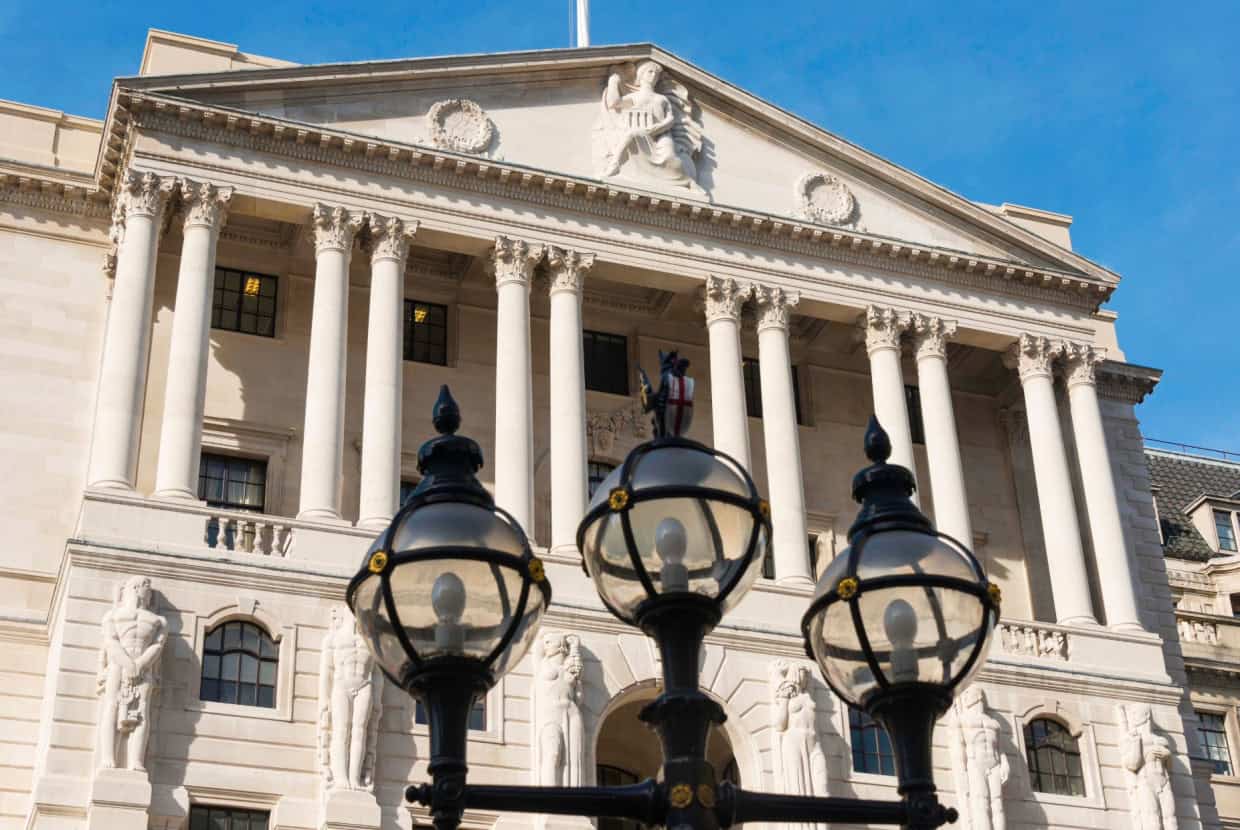
The bank behind your bank: what does the Bank of England do?
The Bank of England (BoE), founded in 1694, is older than the United States. Since being nationalised after World War II, it has taken on a key role in managing the UK economy.

Ross Ellis-Butcher, Marketing Executive
5 min read
What does the Bank of England do?
The Bank of England plays a central role in the UK economy. It sets the base rate, which carries a significant impact on borrowing, saving, and the wider financial system. It is also responsible for quantitative easing, a tool used to stimulate the economy, as well as the printing and circulation of banknotes. In addition, the Bank oversees financial stability through its running of the Prudential Regulation Authority (PRA), which supervises banks (including Kingdom Bank), insurers and major investment firms.
What is the Base (or ‘Bank’) Rate?
The ‘base rate’, set by the BoE, is the interest rate at which commercial banks can borrow from, or deposit with, the bank.
Changes in this rate often influence the rates that banks (including Kingdom Bank) and building societies pass on to their customers, affecting both savings and borrowing.
Each month, a group called the Monetary Policy Committee (which consists of nine experts) meets to decide if the rate should change, typically adjusted in steps of 0.25% or 0.5%.
What does the Base Rate affect?
1 – Savings Rates
Commercial banks (like Kingdom Bank) save money at the BoE (and are obliged to do so by regulators). This means savings interest rates paid to commercial banks can influence the rates paid to customers.
There are other determinants of savings interest rates, such as operational costs, but these typically change less frequently than the bank rate. When you’re notified of a rate change by your bank, it’s usually in response to a BoE rate change.
2 – Mortgage Rates
Commercial banks are not only able to save at the BoE, but they can also borrow from it. They borrow at the same rate as they save. That’s why the rates in the mortgage market can be influenced by the base rate. Some mortgages, called ‘tracker mortgages’, move up or down directly with the base rate.
3 – Inflation
The BoE is tasked with managing inflation in the UK. Their target is for the figure to be at 2%. By changing the base rate, the Bank encourages people to either spend more or save more, depending on what the economy needs. Typically, reducing the rate makes borrowing cheaper and saving less fruitful, encouraging spending and investing, which can drive up inflation, and vice versa.
4 – Exchange Rates
The base rate is one of many determinants of the value of the GBP relative to other currencies. If you have:
€1 saveable at the European Central Bank at 2%*
£1 saveable at BoE at 4%*
This usually makes the pound more attractive to investors, increasing its value compared to other currencies.
The inflation rate can also directly impact exchange rates. If one currency has an inflation rate of 10% and another 1% then traders are likely to make longer term investments in the 1% rate currency, as it will hold more value over time.
*Rates correct as of 27th August 2025
What is the Prudential Regulation Authority (PRA) and what does it do?
Stability is a goal of the Bank. A key resource in maintaining stability is the Prudential Regulation Authority (PRA). The PRA began operation in 2013 and supervises individual organisations (like Kingdom Bank) with the goal of preventing economic crises in the UK. The PRA prioritises assessing whether a firm is likely to fail, and if it does fail, the impact it’d have on the wider financial market.
How does this help me serve Jesus?
Most people aren’t interested in a shift from 2.75% to 3% in the base rate. But there are some important implications:
Refinancing – If you have a family member, friend or colleague who bought or remortgaged when the base rate was over 5% in early 2024 then refinancing now could save a significant amount. It’s also possible that the bank will continue to lower the base rate this year so waiting a little longer could see further savings.
Saving – Finding a balance between how much to save and how much to invest can be tricky. If the base rate is high, savings returns are likely to be more favourable and you can use this to guide your decisions. This can also be coupled with knowledge of the difference compound interest can make to savings.
Financial responsibility – Since the Chancellor handed over responsibility for the Base Rate to the BoE, they have had a major role in our day-to-day life. It also has a significant role in stopping counterfeit currency as well as ensuring we avoid economic crashes. We can thank God for them.
Romans 13:1 teaches us: Let everyone be subject to the governing authorities, for there is no authority except that which God has established. The authorities that exist have been established by God.
In light of this, we’d like to invite you to pray for our regulator.
Prudential Regulation Authority (PRA)
A division of the Bank of England who is responsible for the economic stability and avoiding a crisis in the market.
Prayer points for the PRA:
- Give thanks that they exist and want to keep our economy stable and by extension, jobs secure, and people out of poverty and housed securely.
- Their forward-looking stress testing – we pray for wisdom for their experts when envisaging what unexpected things can occur.
You can read about the most recent change in the base rate here.
You can see our savings rates and mortgage rates. Here at Kingdom Bank, our rates are influenced by the Bank of England base rate, but we first seek to serve Gospel ministries across the UK. If you’d like to partner with us in making mortgages for ministries possible then save with us.
About the author
Ross has been a Marketing Executive at Kingdom Bank since 2024, with experience in high street and start-up banks. He is passionate about facilitating positive and effective communication and engagement between the Bank and its customers.
Ross Ellis-Butcher, Marketing Executive